A field guide for the curious mind

INNER INQUIRY, Issue 06Mind Wandering and Attention

Is meditation meant to relax you, or wake you up?

A new brain wave study says meditation isn't just relaxing. Plus an old Buddhist lesson about tuning strings, a list of wake up tips, and a three minute check, with honest limits.

Ancient wisdom. Modern science. Deeper questions.

By Rishi B.November 6, 20267 min read

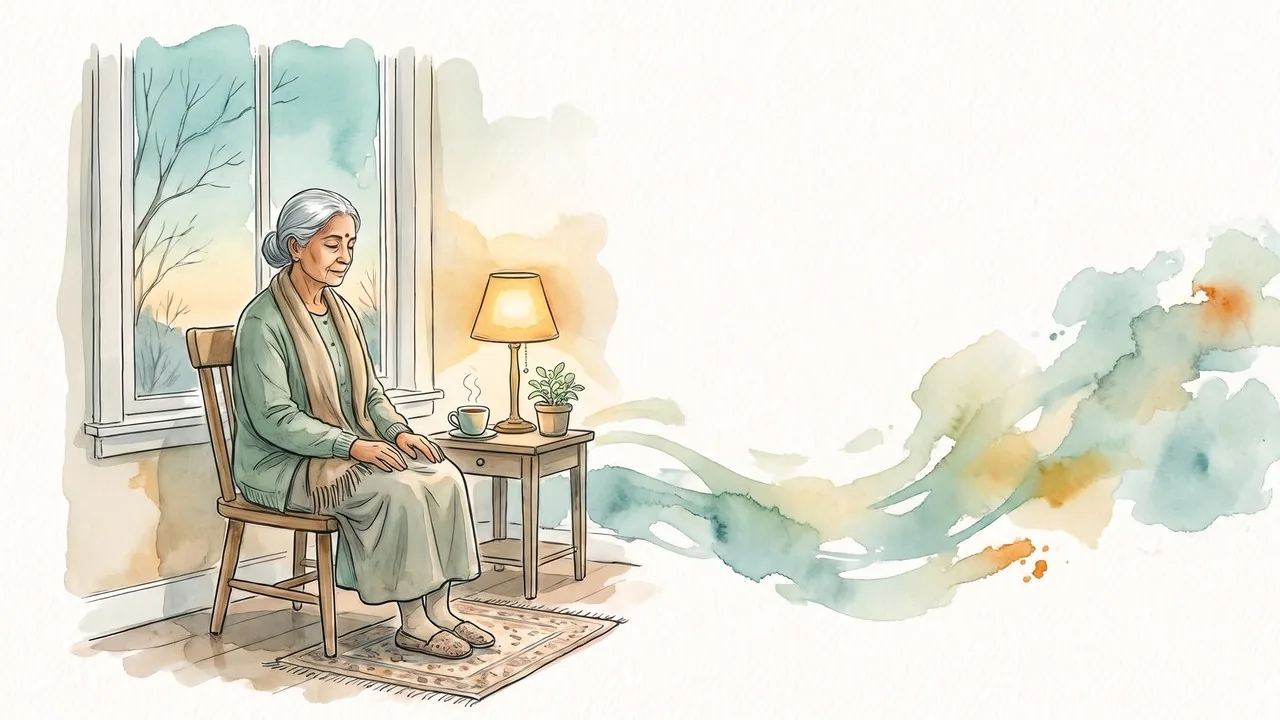
An older woman with silver hair sits upright on a wooden chair by a tall window at dawn, eyes softly lowered, hands resting on her knees, with a lit lamp, a cup of tea and a small plant on the table beside her.

You sit down to meditate. Eyes closed, back against the chair, the room still dim. You follow one breath, then another.

A few minutes later your chin dips. You jerk upright and wonder: was that meditation, or a nap?

If that sounds familiar, you have plenty of company. Falling asleep while meditating is an old problem, old enough that the Buddha's own students had it. And these short November days don't help.

It hides a bigger question.

Is meditation meant to relax you until you drift off, or to wake you up?

A study published last month looked inside the brain to find out, and an old Buddhist conversation about a musical instrument gives a surprisingly similar answer.

Falling asleep while meditating is common, and it raises a real question about what meditation is for. This article looks at what a new 2026 brain wave study found, what two old Buddhist texts say about sleepiness, and a short practice for staying awake without straining. We label each claim so you can see how solid it is:

  • SUPPORTED: backed by a systematic review, meta-analysis or major guideline
  • EMERGING: promising but early, small, or mixed
  • TRADITIONAL: what a tradition teaches, or the history of a practice
  • PHILOSOPHICAL: interpretation, not a testable fact
  • SPECULATIVE: a reasonable idea not yet shown

Is meditation relaxing or alerting? The idea, simply

There are two common pictures of meditation.

In one, meditation is a way to relax. You slow down, your body settles, and if you drift off, no harm done.

In the other, meditation is a way to train attention. You stay awake and clear, and you keep noticing what is happening, even when it's dull.

Scientists often describe it as a mix of both: relaxed alertness. Calm in the body, awake in the mind.

Two words help here. Arousal is how switched on your body is: heart rate, sweat, readiness to act. Alertness is how awake your attention is. They often move together, but not always. That is what the new study tried to pull apart.

The ancient lens: tuning the strings, and a monk who nodded off

Old Buddhist texts describe meditation as a balance. A 2014 review of these texts put it this way: meditation must guard against restlessness on one side and drowsiness and sleep on the other. TRADITIONAL

The best known picture of that balance is about music. In the Sona Sutta (Anguttara Nikaya 6.55), a monk named Sona has pushed his practice so hard that he is ready to quit. He used to play the vina, a stringed instrument. The Buddha asks him: was it playable when the strings were too tight? Too loose? Or only when they were "neither too taut nor too loose"? TRADITIONAL

Then comes the lesson, in Thanissaro Bhikkhu's translation: "over-aroused persistence leads to restlessness, overly slack persistence leads to laziness." TRADITIONAL

A second text is almost funny. In the Capala Sutta (Anguttara Nikaya 7.58), the Buddha finds his student Moggallana dozing and asks: "Are you nodding, Moggallāna? Are you nodding?" TRADITIONAL

What follows is a list of things to try, one after another, if sleepiness won't lift. Stop following the thought you were on when drowsiness came. Recall a teaching, or say it out loud. "Pull both your earlobes and rub your limbs with your hands." Get up, wash your eyes with water and look up at the stars. Bring to mind the idea of light. Walk back and forth. And if none of that works, lie down mindfully and get up as soon as you wake. TRADITIONAL

There is no scolding in it. It reads like practical advice for a very normal problem. That reading is ours. PHILOSOPHICAL

The modern evidence: what meditation brain waves showed

The new study. On October 9, 2026, researchers at the University of Wollongong in Australia published a study in Psychophysiology. They recorded the brain waves (EEG) of 42 young adults, plus the sweat on their fingertips, a common sign of how switched on the body is. Everyone was a beginner, with between zero and 50 hours of meditation in their whole life. EMERGING

They sat upright in a chair, in a dimly lit room. First, two minutes of resting with eyes closed. Then 15 minutes of breath focused meditation, with eyes closed: six minutes guided, nine minutes in silence. EMERGING

What they found. During meditation, theta waves were stronger than during rest. In past research, theta has been linked with turning attention inward and noticing what is going on. Skin sweat did not change overall: it dipped a little at first, then rose again later. EMERGING

The authors' conclusion: meditation was "not simply characterized by reduced arousal." The pattern fit relaxed alertness better than simple relaxation. EMERGING

The twist. Slower delta waves crept up across the eight minutes they analysed. The authors say this could mean people were settling deeper into the practice. But they add that growing drowsiness is "an equally plausible explanation", because delta also rises as we get sleepy. Since rest always came first, they couldn't separate meditation from simply sitting still for longer with eyes closed. EMERGING

So even in a lab, the line between a calm, alert mind and the edge of sleep was hard to see.

How you breathe changes the picture. In an earlier 2026 study, the same team randomly split 80 young adults into two groups. One meditated breathing naturally. The other deliberately slowed the breath. With slow breathing, theta rose more and skin sweat went up. With natural breathing, sweat went down. EMERGING (Issue 04 compared two paced breathing methods.)

Where sleepiness sneaks in. The 2014 review notes that mind wandering tends to go with lower alertness, and with the same slow delta waves that signal sleepiness. EMERGING (Issue 02 looked at what a wandering mind does to mood.) The reviewers also suggest that early practice, which takes more effort, may bring more sleepiness, and that later stages may bring more wakefulness. That is a proposal, not a tested result. SPECULATIVE

Where they meet

The vina and the brain data point the same way. Meditation isn't a slow slide toward sleep, and it isn't straining either. It's more like tuning: not too tight, not too loose. PHILOSOPHICAL

That makes nodding off less of a failure and more of a signal. The strings went slack. You can tighten them a little. PHILOSOPHICAL

Where they differ, or remain unsure

The study was small: 42 young beginners, one session, eight minutes analysed. It didn't ask people how sleepy they felt, and it didn't measure their breathing. EMERGING

Brain wave results also shift between studies. In the same team's 2024 study of 52 young adults, alpha waves dropped during meditation and theta didn't change in the standard analysis. In 2026, theta rose and alpha didn't reliably change. EMERGING So brain waves are not a simple "meditation meter". PHILOSOPHICAL

The traditions are talking about years of practice, toward a deep goal. The lab measured a few minutes of beginners in a chair. Those are very different windows.

And sometimes sleep is simply what your body is asking for. If you nod off every time you sit, it may be telling you more about your nights than about your meditation. A practice built for deep rest, like yoga nidra (Issue 03), is a different thing, and drifting off there is less of a problem.

How to stay awake while meditating: a three minute check (optional)

This is a small experiment, not a treatment.

  1. Set the seat (30 seconds). Sit upright on a chair, feet flat. Keep the light on. Let your eyes stay a little open, resting on the floor a short way ahead.
  2. Follow and check (2 minutes). Follow the breath. Every so often, ask: too tight, or too loose? Too tight feels like a clenched jaw, effort, restlessness. Soften the shoulders and let the breath be. Too loose feels like a heavy head and dreamy drifting. Sit a little taller, open your eyes a bit wider, and take a few fuller breaths.
  3. If you still nod (30 seconds). Borrow from the old list. Rub your hands and arms. Splash cool water on your face. Look out of a window or up at the sky. Or stand and take a few slow steps.

Afterwards, notice: did you tend to run tight, or loose, today?

A gentle note. The U.S. National Center for Complementary and Integrative Health says meditation usually has few risks, but a 2020 review it cites found about 8 percent of participants had a negative effect, most often anxiety or depression. If meditating stirs up something heavy, stop and come back another time.

This article is for education only and is not medical advice. If you feel very sleepy most days, or fall asleep when you don't mean to, talk with a health care provider.

If you liked this, Issue 05 asked whether living in the present moment makes you careless about the future.

One question to carry

Right now, are your strings too tight, too loose, or close to tuned?

Sources

  1. Duda AT, Clarke AR, Barry RJ. (2026). Neural oscillatory and sympathetic arousal dynamics during mindfulness meditation: Characterizing relaxed alertness. Psychophysiology, 63(10), e70425. Published online 9 October 2026. Open access.
  2. Duda AT, Clarke AR, Barry RJ. (2026). Intentional slow breathing versus spontaneous breathing during mindfulness meditation differentially affects electroencephalographic oscillations and skin conductance. Mindfulness.
  3. Duda AT, Clarke AR, Barry RJ. (2024). Mindfulness meditation alters neural oscillations independently of arousal. International Journal of Psychophysiology.
  4. Britton WB, Lindahl JR, Cahn BR, Davis JH, Goldman RE. (2014). Awakening is not a metaphor: the effects of Buddhist meditation practices on basic wakefulness. Annals of the New York Academy of Sciences, 1307, 64 to 81.
  5. Thanissaro Bhikkhu (trans.). About Sona, Sona Sutta (AN 6.55).
  6. Thanissaro Bhikkhu (trans.). Nodding, Capala Sutta (AN 7.58).
  7. NCCIH. Meditation and Mindfulness: Effectiveness and Safety.

Your turn. Try the three minute check once this week. Subscribe to get the next issue, and reply to any email to tell us what you noticed: do you tend to run tight or loose when you sit? If a friend has given up on meditation because they "just fall asleep", share this with them.

Common questions

Is it normal to fall asleep while meditating?

It is common, and it is an old problem. In a Buddhist text called the Capala Sutta (AN 7.58), the Buddha finds his student Moggallana dozing and gives him a list of things to try. In a 2026 lab study of 42 beginners meditating with eyes closed in a dim room, slow delta waves crept up over eight minutes, which the researchers said could reflect settling in or growing drowsiness.

What happens to brain waves during meditation?

In a small study published in Psychophysiology in October 2026, 42 young beginners showed stronger theta waves during a 15 minute breath meditation than during eyes closed rest, while skin sweat (a sign of body arousal) did not change overall. The authors described the pattern as relaxed alertness rather than simple relaxation. Results vary between studies, so brain waves are not a simple meditation meter.

Is meditation supposed to relax you or make you alert?

Both, in balance. A 2014 review describes traditional Buddhist teaching as relaxed alertness that guards against restlessness on one side and drowsiness on the other. In the Sona Sutta (AN 6.55), the Buddha compares practice to tuning a stringed instrument: "neither too taut nor too loose."

How can I stay awake while meditating?

Sit upright on a chair with your feet flat, keep a light on, and let your eyes stay a little open. If you feel heavy, sit taller and take a few fuller breaths. If you still nod, rub your hands and arms, splash cool water on your face, look out of a window, or stand and take a few slow steps. If you feel very sleepy most days, talk with a health care provider.

Keep reading

About the author

Rishi B. writes INNER INQUIRY, reading old contemplative texts next to current research on breath, attention and rest. Every source is linked and every claim carries an evidence label. Short notes at @innerinquiry.daily.

Get the next issue free every Tuesday and Friday