A field guide for the curious mind

INNER INQUIRY, Issue 05Mindfulness and Attention

Does living in the present moment cost you the future?

Four new studies tested a common worry about mindfulness and the future. Plus a Stoic letter, a Buddhist verse, and a two minute practice, with honest limits.

Ancient wisdom. Modern science. Deeper questions.

By Rishi B.November 4, 20267 min read

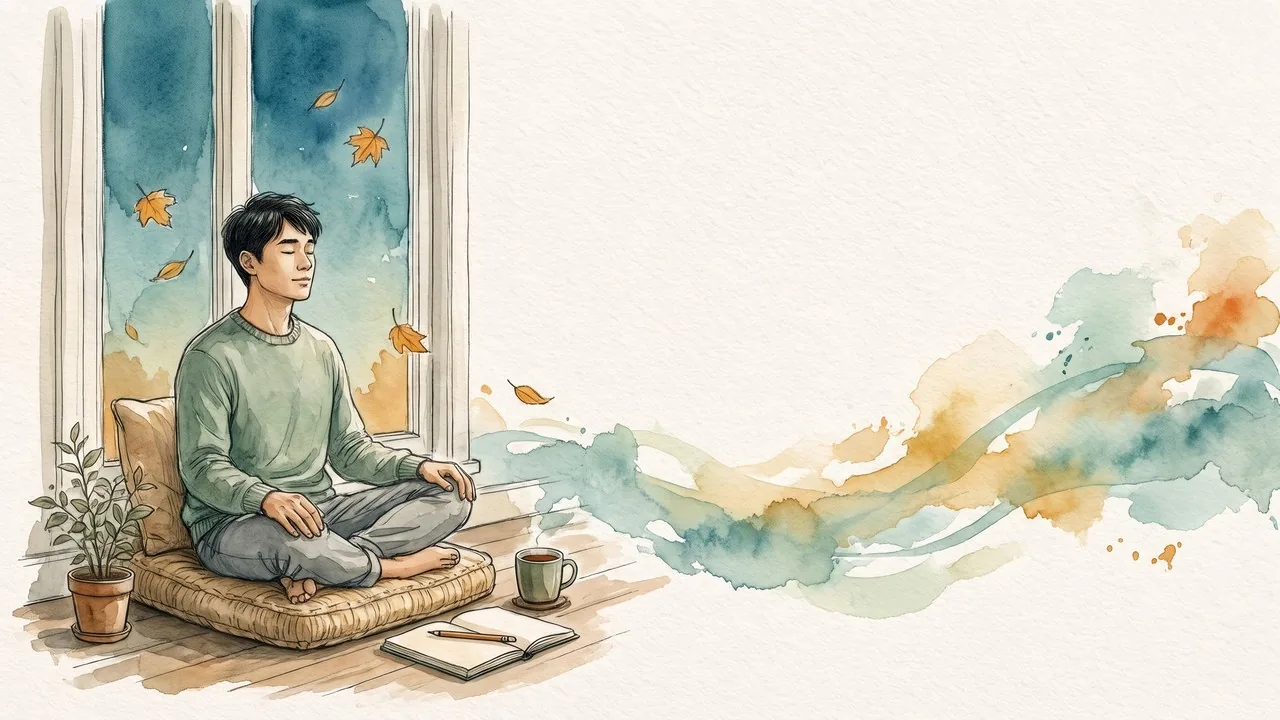
A man sits cross-legged on a floor cushion by a tall window, eyes closed, as autumn leaves drift past outside, with a cup of tea, an open notebook and a small plant beside him.

On Sunday, most clocks in Canada and the U.S. went back an hour. For one morning, a lot of us got a little time back.

What did you do with yours? Sleep in? Scroll? Plan the week?

There's a common worry about mindfulness hiding in that question.

If you train yourself to live in the present moment, do you stop caring about the future?

Do you save less, plan less, and reach for the easy thing now? A new set of studies put that worry to a test.

Living in the present moment is one of the most quoted ideas in mindfulness. This issue looks at what four new studies found about it and the future, what a Buddhist verse and a Stoic letter actually say, and a short practice for doing both. We label each claim so you can see how solid it is:

  • SUPPORTED: backed by a systematic review, meta-analysis or major guideline
  • EMERGING: promising but early, small, or mixed
  • TRADITIONAL: what a tradition teaches, or the history of a practice
  • PHILOSOPHICAL: interpretation, not a testable fact
  • SPECULATIVE: a reasonable idea not yet shown

What is present bias, and why worry about mindfulness?

Many choices are a trade between now and later. Fifty dollars today, or seventy next month. Dessert now, or feeling good tomorrow. Scrolling tonight, or a rested morning.

Most of us lean a little toward now. Researchers call this present bias: giving a smaller reward today more weight than a bigger one later.

Mindfulness asks you to rest your attention on what is happening now, like the breath or the feet on the floor. (Issue 01 looked at what slow breathing does in the body.) When the mind drifts into tomorrow, you gently come back.

So here is the worry. Thinking about the future seems to help people wait for bigger rewards. If mindfulness trains you to step out of those thoughts, could it make you more impatient? It's a fair question. But until recently, it was mostly a guess. SPECULATIVE

The ancient lens: the present, with work in it

Two old texts that praise the present do not tell people to forget tomorrow. They pair it with work.

A Buddhist verse called "An Auspicious Day" (Majjhima Nikaya 131), in Thanissaro Bhikkhu's translation, begins: "You shouldn't chase after the past or place expectations on the future." A few lines later it adds: "Ardently doing what should be done today." TRADITIONAL

In the explanation that follows, "placing expectations on the future" means getting carried away with delight in what body, feelings or thoughts you might have one day. TRADITIONAL So the warning seems to be about being swept off by hopes, not about making plans. PHILOSOPHICAL

The Stoic Seneca made a similar point in the first of his letters to his friend Lucilius. In Richard Mott Gummere's translation: "hold every hour in your grasp. Lay hold of to-day's task, and you will not need to depend so much upon to-morrow's. While we are postponing, life speeds by." TRADITIONAL

Read together, both treat the present as the place where you look after the future, not a place to hide from it. That reading is ours, not a claim about history. PHILOSOPHICAL

The modern evidence: does mindfulness make you impatient?

Four studies, one question. A paper published on October 15, 2026 in Scientific Reports asked whether mindfulness makes people more present biased. The team, from universities and a mindfulness institute in Spain, ran three lab studies and one field study. EMERGING

In the lab. In total, 852 people, mostly students around 21 years old, listened to a 15 minute audio. One group did a guided breath meditation. Another was told to let the mind wander. A third did nothing first. Then everyone made money choices: a smaller amount sooner or a larger amount later. One study used everyday scenarios, like how to split a monthly pay cheque or whether to borrow for a car or save for two years. Another used real money, paid out to 1 in 25 people. EMERGING

The result: no difference. Meditating first did not make people choose the quick money more often. In the first study, about 71 to 73 percent of choices were for the larger, later amount in every group. The only small signal, in the real money study, pointed slightly toward more patience after meditating, and it did not repeat in the other studies. EMERGING

After eight weeks. In the field study, 57 people took a standard eight week Mindfulness Based Stress Reduction course, with daily home practice. Before the course, 64 percent of their choices were for the later reward. After, 67 percent. That change was small and not significant. Twelve people became more patient, ten less, and 35 didn't change. This study had no comparison group and about a third of people dropped out, so it's a check, not proof. EMERGING

A study that leaned the other way. A 2025 paper in the International Journal of Research in Marketing ran six studies and found that mindfulness made people more willing to wait for a larger reward. The authors think it slows the felt passage of time, so the future feels roomier. That explanation is still being tested. EMERGING

Why the worry made sense. It's well established in the lab that vividly imagining your own future nudges people toward bigger, later rewards. A 2022 meta-analysis of 48 articles found a medium sized effect, stronger when the imagined events were positive, vivid and linked to the choice. SUPPORTED And one 2013 study found that people whose minds wandered more during an easy task were willing to wait longer for money. EMERGING (Issue 02 looked at the other side of mind wandering: how it can pull mood down.)

Where they meet

The verse, the letter and the studies agree on a simple point. Being present and caring about the future are not opposites. PHILOSOPHICAL

Seneca put the link plainly: take hold of today's task, and tomorrow leans on you less. The new studies found that time spent attending to the present did not make people grab the quick reward. EMERGING

Where they differ, or remain unsure

The traditions are talking about a whole way of living. The studies measured money choices, on one day, mostly in young Spanish students. That is a narrow window on "the future."

The lab practice was 15 minutes. Long term meditators, or other kinds of practice, might be different. And the authors note mixed earlier results, including a study in which a mindful eating program went with more present focused choices in food insecure women. EMERGING

Why doesn't present focus make people impatient? One idea is ours: mindfulness may change how you hold thoughts about the future, seeing a plan as a plan and a worry as a worry, without removing them. That hasn't been tested. SPECULATIVE

Here, then next: a two minute practice (optional)

This is a small reflection, not a treatment. Evening, as the light goes earlier this week, is a good time to try it.

  1. One minute here. Sit, feel your feet and a few easy breaths. When your mind jumps to tomorrow, notice "planning" and come back.
  2. One minute next. Pick one thing future you will care about: a bill, a call, a walk, a bedtime. Picture it clearly, where you are, what time it is, how it feels once it's done.
  3. Today's piece. Ask: what small part of that can I do now? Do it, or put it in your calendar.

Afterwards, notice: did the future step feel lighter or heavier after a minute of being here?

A gentle note. The future thinking evidence comes from lab choices, not life outcomes, so treat this as an experiment. If picturing the future brings up worry, pick something small and kind, or skip step 2. The U.S. National Center for Complementary and Integrative Health says meditation usually has few risks, but a 2020 review it cites found about 8 percent of participants had a negative effect, most often anxiety or depression.

This newsletter is for education only and is not medical advice. If worry about the future is heavy or constant, talk with a health care provider.

One question to carry

When you plan, are you living in the future, or looking after it from here?

Sources

  1. Gisbert J, Navarro-Martinez D, Martín-Asuero A, Quoidbach J. (2026). Mindfulness meditation does not make people more present-biased. Scientific Reports. Published 15 October 2026. Open access.
  2. Errmann A, Seo Y, Septianto F, Chu X-Y. (2025). Slowing time, shaping the future: The effect of mindfulness on intertemporal choice. International Journal of Research in Marketing.
  3. Rösch SA, Stramaccia DF, Benoit RG. (2022). Promoting farsighted decisions via episodic future thinking: A meta-analysis. Journal of Experimental Psychology: General.
  4. Smallwood J, Ruby FJM, Singer T. (2013). Letting go of the present: Mind-wandering is associated with reduced delay discounting. Consciousness and Cognition, 22(1), 1 to 7.
  5. Thanissaro Bhikkhu (trans.). An Auspicious Day, Bhaddekaratta Sutta (MN 131).
  6. Seneca, trans. R. M. Gummere. Moral Letters to Lucilius, Letter 1: On saving time.
  7. NCCIH. Meditation and Mindfulness: Effectiveness and Safety.

If you want a one minute way into "here," Issue 04 compared two short breathing patterns.

Your turn. Try "here, then next" once this week. Subscribe to get the next issue, and reply to any email to tell us what you noticed: did the future step feel lighter after a minute of being here, or not? If a friend worries that mindfulness will make them lazy, share this with them.

Common questions

Does living in the present moment make you careless about the future?

Four studies published in Scientific Reports in October 2026 found no sign of it. In three lab studies with 852 people, mostly students in Spain, a 15 minute breath meditation did not make people choose smaller, sooner money over larger, later money. In a fourth study, 57 people who took an eight week mindfulness course made about the same choices before and after. It is one research team's work, so treat it as early evidence.

What is present bias?

Present bias is giving a smaller reward today more weight than a bigger reward later, such as taking fifty dollars now instead of seventy next month. Most people lean a little toward now.

Did the Buddha or the Stoics say to ignore the future?

Not in the texts quoted here. A Buddhist verse, "An Auspicious Day" (MN 131), says not to chase the past or place expectations on the future, and in the same breath praises "Ardently doing what should be done today." Seneca told Lucilius to "hold every hour in your grasp" so that he would not need to depend so much on tomorrow. Both pair the present with work that looks after the future.

How can I be present and still plan ahead?

One option is the two minute "here, then next" practice: one minute of attention to your feet and breath, one minute picturing one thing future you will care about, then one small step today. Lab research finds that vividly imagining your own future nudges people toward later, larger rewards, but that evidence is about lab choices, not life outcomes. Skip the future step if it stirs up worry.

Keep reading

About the author

Rishi B. writes INNER INQUIRY, reading old contemplative texts next to current research on breath, attention and rest. Every source is linked and every claim carries an evidence label. Short notes at @innerinquiry.daily.

Get the next issue free every Tuesday and Friday