A field guide for the curious mind

INNER INQUIRY, Issue 03Rest and Deep Relaxation

Is yoga nidra real rest?

A plain look at yoga nidra: where the practice comes from, what sleep trials and a small brain scan study found, and where the evidence is still thin.

Ancient wisdom. Modern science. Deeper questions.

By Rishi B.October 21, 20269 min read

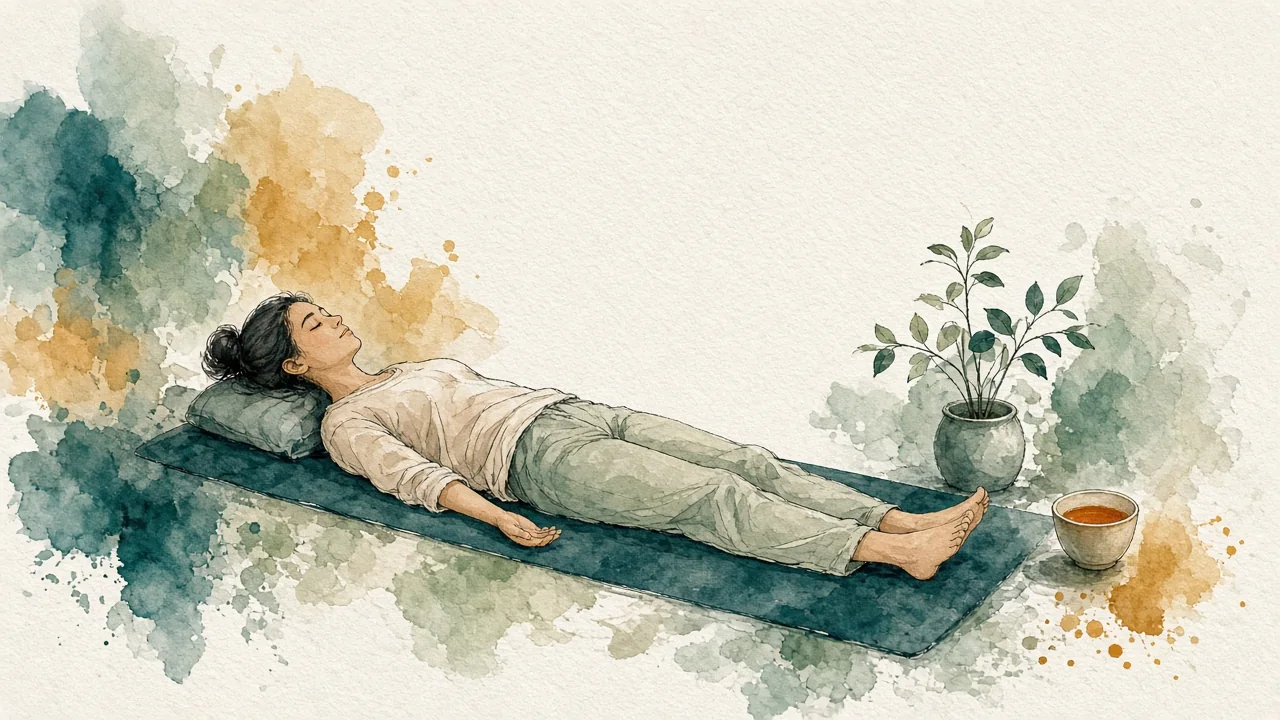
A person rests on their back on a mat with a pillow, a plant and a cup of tea beside them.

It's mid afternoon and you're tired in the heavy way coffee doesn't fix. You can't really nap, so you lie on the floor for ten minutes, close your eyes, and wonder if that counted for anything.

That question is behind a lot of searches for yoga nidra, often called "yogic sleep." But the point isn't to fall asleep. It's to rest while staying quietly aware.

So is it real rest, or just a nice story? This issue looks at the tradition and the evidence, and keeps them apart. We label each claim so you can see how solid it is:

  • SUPPORTED: backed by a systematic review, meta-analysis or major guideline
  • EMERGING: promising but early, small, or mixed
  • TRADITIONAL: what a tradition teaches, or the history of a practice
  • PHILOSOPHICAL: interpretation, not a testable fact
  • SPECULATIVE: a reasonable idea not yet shown

What is yoga nidra?

Yoga nidra is a guided practice, usually done lying down. A voice walks your attention slowly through the body, sometimes adds the breath or simple imagery, and then brings you back. The sessions in the studies below ran from an 11 minute audio to a 72 minute guided session.

The name is confusing. Yoga means union or practice, and nidra means sleep. Sleep is where awareness fades. This is closer to deliberate rest with your attention still gently on.

You may also meet it under the name non-sleep deep rest, or NSDR. Popular explainers describe NSDR as a secular, yoga nidra style protocol. It sits in the same family as body scan meditation.

The ancient lens

Old texts on sleep and awareness. The Mandukya Upanishad is a short Sanskrit text that describes waking, dreaming and deep sleep as three states of experience, then points to a "fourth" beyond them. In Swami Nikhilananda's translation, deep sleep is: TRADITIONAL

"That is the state of deep sleep wherein one asleep neither desires any object nor sees any dream."

The text then uses these states to talk about the nature of the self. It's a philosophical map, not a relaxation technique, and the early texts of this tradition mostly don't use the word yoganidra. TRADITIONAL

The guided practice is newer than it sounds. Sanskrit scholar Jason Birch and Jacqueline Hargreaves traced the history of the term. Yoganidra appears in older Sanskrit literature with varied meanings, including a meditative state and later the name of a posture. The seven part guided technique most people mean today was set out in Swami Satyananda Saraswati's 1976 book, Yoga Nidra. He wrote that he built it from practices he found in tantric texts. TRADITIONAL

Birch and Hargreaves find older precedents for pieces of it: lying on the ground to quiet the mind, a tantric practice of placing attention on parts of the body (nyasa), and a medieval practice of moving the breath through points in the body. But they describe the full structure as Satyananda's own systematization, and they note that one step, a short positive resolve, appears to echo Western relaxation methods of the 1800s. TRADITIONAL

Our reading: that doesn't make the practice less useful. It means "ancient" is only part of the story. A modern practice can borrow from old ideas and still be thoughtful, and it deserves to be judged by what it does, not by how old it sounds. PHILOSOPHICAL

The modern evidence

Sleep trials. A 2025 systematic review in the Journal of Integrative and Complementary Medicine searched for randomized trials of yoga nidra and sleep up to March 2025. It included six trials with 244 people in total, including people with chronic insomnia, acute insomnia, hypertension, sportspersons and COVID-19 health care workers. Most trials reported improvements in sleep onset, total sleep time and sleep efficiency, compared with controls such as CBT-I, progressive muscle relaxation and music relaxation. But protocols, measures and length varied, most studies had moderate to high risk of bias because they weren't blinded or reported incompletely, and adverse events were poorly reported. The authors say yoga nidra "appears to show promise" and that stronger trials are needed. EMERGING

A more cautious pooled analysis. A 2026 systematic review and meta-analysis in Sleep and Breathing looked at adults with poor sleep quality or insomnia. It found two randomized trials for the Pittsburgh Sleep Quality Index (181 people) and two for the Insomnia Severity Index (99 people). The pooled effects were large on paper but not statistically significant, and the authors rated the certainty of the evidence as very low and the findings as preliminary and hypothesis generating. They also note that trials were concentrated in India. EMERGING

A short practice in a large sample. In a German online study published in Current Psychology in 2022, 341 people listened to an 11 minute yoga nidra audio on their own for 30 days, and 430 people were on a wait list. Compared with the wait list, the practice group reported lower stress, higher well-being and better sleep quality. The effect sizes were very small to small, effects held six weeks later, and there was no active comparison group, such as another relaxing activity. About 80% of participants were women. EMERGING

One brain scan study. In a 2002 study in Cognitive Brain Research, eight healthy male meditation teachers aged 31 to 50, with 7 to 26 years of daily practice, were scanned with PET during a 72 minute guided session and during a control condition of listening to speech. During yoga nidra, a tracer that competes with dopamine in the ventral striatum bound 7.9% less, which the authors converted to an estimated 65% increase in dopamine release. The change was linked to more theta activity on EEG, and as a group the participants reported less desire for action and more vivid sensory imagery. It's a very small study of expert practitioners, and we did not find a replication. EMERGING What this means for everyday mood, rest or sleep is not known. SPECULATIVE

A better studied cousin. For mindfulness meditation more broadly, a 2019 meta-analysis in Annals of the New York Academy of Sciences pooled 18 trials with 1,654 people. It found moderate strength evidence that mindfulness meditation improved sleep quality compared with nonspecific active controls, and no clear difference compared with established sleep treatments, and the authors called the findings preliminary. SUPPORTED That is not a study of yoga nidra itself. It just suggests that calm, guided attention practices are a reasonable thing to study for sleep.

Where they meet

The old texts and today's researchers both treat rest and sleep as states worth looking at closely, not as blank time. And both suggest that resting can be a skill you practice, not only something that happens to you. PHILOSOPHICAL

Where they differ, or remain unsure

Different questions. The Upanishad is asking what the self is. The trials ask about sleep scores and stress. A practice can be meaningful in one frame and untested in the other.

Not a replacement for sleep, or for treatment. For chronic insomnia, the American College of Physicians recommends cognitive behavioral therapy for insomnia (CBT-I) as the initial treatment. SUPPORTED Yoga nidra has not been shown to match that. One trial in the sleep review used CBT-I as a comparison, but the review rates most trials as having moderate to high risk of bias, so that shouldn't be read as proof that yoga nidra can replace it.

Open questions. We don't know if yoga nidra beats other relaxation methods, which version works best, how long or how often to practice, or who is most likely to benefit. Most trials were small, many were done in India, and most were not blinded. SPECULATIVE

Mechanisms are unclear. The dopamine finding is interesting, but one small PET study does not explain why anyone feels rested after a session. SPECULATIVE

A 5 minute practice (optional)

This is a gentle rest experiment, not a treatment, and not a way to force sleep. You can find longer guided recordings online, but you don't need one to try this.

  1. Lie down somewhere comfortable, or sit with your back supported. Let your eyes close, or rest them on one spot. Decide that you're resting, not trying to sleep.
  2. Spend a few breaths noticing what is holding you up: the floor, the chair, the bed.
  3. Move your attention slowly through the body: right hand, arm and shoulder, then left. Then face and jaw, chest and belly, hips, legs and feet. A few seconds each. Just notice. You don't have to relax on command.
  4. When your mind leaves, come back to the last place you remember. No scolding.
  5. After about five minutes, take one bigger breath, wiggle your fingers and toes, and open your eyes slowly.

If lying flat isn't comfortable, sit supported or lie on your side.

Safety note. Stop if you feel anxious, restless, dizzy or uncomfortable, and return to ordinary activity. The U.S. National Center for Complementary and Integrative Health says meditation practices usually have few risks, but notes that few studies have looked for harms. A 2020 review it cites found that about 8 percent of participants had a negative effect, most often anxiety or depression. Body focused practices can stir up strong sensations for some people, especially with a trauma history. If that's you, keep your eyes open, pick a neutral anchor like sounds in the room, or skip it and talk with a clinician. Don't practice while driving, or anywhere that falling asleep would be unsafe.

Not medical advice. INNER INQUIRY is for education and curiosity. It doesn't replace care from a qualified professional. If sleep problems last or affect your days, see a health care provider, and don't use a practice like this to replace needed care.

One question to carry

When you rest, are you really resting, or are you waiting to get back to something?

Sources

  1. Dutta A, Mooventhan A, Nivethitha L, Dharani E. (2025). Efficacy of Yoga Nidra in Managing Sleep Disorders: A Systematic Review of Randomized Controlled Trials. Journal of Integrative and Complementary Medicine, 32, 235 to 241.
  2. Singh S, Dhanlika D, Singh U, Haldar P, Sharma G. (2026). Effect of yoga Nidra (yogic sleep) in sleep disturbances and insomnia: systematic review and metanalysis. Sleep and Breathing, 30, 144.
  3. Moszeik EN, von Oertzen T, Renner K-H. (2022). Effectiveness of a short Yoga Nidra meditation on stress, sleep, and well-being in a large and diverse sample. Current Psychology, 41(8), 5272 to 5286.
  4. Kjaer TW, Bertelsen C, Piccini P, Brooks D, Alving J, Lou HC. (2002). Increased dopamine tone during meditation-induced change of consciousness. Cognitive Brain Research, 13(2), 255 to 259.
  5. Rusch HL, Rosario M, Levison LM, et al. (2019). The effect of mindfulness meditation on sleep quality: a systematic review and meta-analysis of randomized controlled trials. Annals of the New York Academy of Sciences, 1445(1), 5 to 16.
  6. Qaseem A, Kansagara D, Forciea MA, Cooke M, Denberg TD. (2016). Management of Chronic Insomnia Disorder in Adults: A Clinical Practice Guideline From the American College of Physicians. Annals of Internal Medicine, 165(2), 125 to 133.
  7. Birch J, Hargreaves J. Yoganidra: An Understanding of the History and Context. Published online 2014.
  8. Nikhilananda S (trans.). Mandukya Upanishad with Gaudapada's Karikas, from The Upanishads: A New Translation.
  9. NCCIH. Meditation and Mindfulness: Effectiveness and Safety.
  10. Simply Psychology. NSDR (Non-Sleep Deep Rest): The Science and How To Do It. Popular explainer, used only for how NSDR is described, not as evidence.

Your turn. Try the practice once this week. Subscribe to get the next issue, and reply to any email to tell us what you noticed. Even "I fell asleep" or "nothing much" is useful. If this helped you think more clearly about rest, share it with one curious friend.

Common questions

What is yoga nidra?

Yoga nidra is a guided practice, usually done lying down, in which a voice slowly moves your attention through the body and then brings you back. The name means "yogic sleep," but the aim is to rest while staying quietly aware. The full seven part method was set out by Swami Satyananda Saraswati in 1976.

Does yoga nidra help with sleep?

The evidence is early. A 2025 review of six small randomised trials found most reported better sleep, but the trials had moderate to high risk of bias. A 2026 meta-analysis found pooled results that were not statistically significant, with very low certainty. Yoga nidra is not a proven treatment for insomnia.

Is yoga nidra the same as non-sleep deep rest (NSDR)?

They are close cousins. Yoga nidra sits in the same family as body scan meditation and the "non-sleep deep rest" sessions you can find online: guided rest with your attention gently on.

Can yoga nidra replace sleep or insomnia treatment?

No. For chronic insomnia, the American College of Physicians recommends cognitive behavioral therapy for insomnia (CBT-I) as the first treatment. If sleep problems last or affect your days, see a health care provider.

Keep reading

About the author

Rishi B. writes INNER INQUIRY, reading old contemplative texts next to current research on breath, attention and rest. Every source is linked and every claim carries an evidence label. Short notes at @innerinquiry.daily.

Get the next issue free every Tuesday and Friday