A field guide for the curious mind

INNER INQUIRY, Issue 10Mind and Stress

Mindfulness may not reduce stress at first: what a new trial found

A new trial: more felt stress, yet lower heart rate in stressful moments. The big reviews, the Buddha's two barbs, a Stoic line, a 2-minute practice, and honest limits.

Ancient wisdom. Modern science. Deeper questions.

By Rishi B.November 20, 20268 min read

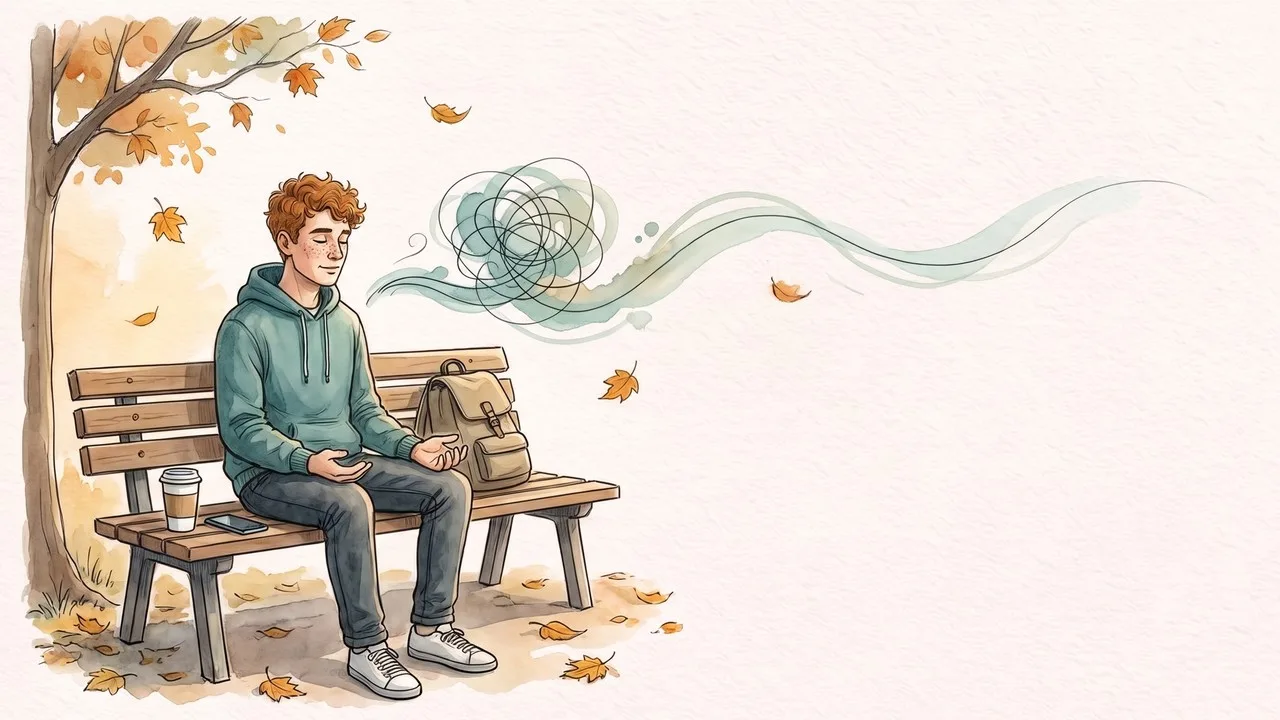
A young man with curly auburn hair and freckles, in a teal hoodie, sits on a wooden park bench in autumn with his eyes closed and his hands resting open in his lap. A backpack, a paper coffee cup and his phone sit beside him, leaves drift down from a tree, and a small tangle of ink lines near his shoulder loosens into one soft flowing line.

After two weeks of mindfulness, people felt more stressed, not less. That's what a small trial published on October 28 found. But in stressful moments, their heart rate stayed lower than in a comparison group. If you've ever sat down to meditate and felt everything get louder, here's what may be going on, with the full evidence, every caveat, and a 2-minute practice.

Work has been a lot, so you try a mindfulness app. Ten minutes a day. On day three, you sit down and start to notice things.

Your jaw is tight. Your shoulders are up near your ears. There's an email you've been dreading since Monday.

You came to feel calmer. Instead, you feel everything.

So you wonder: is mindfulness making me more stressed? The trial above suggests that, at least at first, it can feel that way.

We read that trial, an older one that tried to pull mindfulness apart, the big reviews, and an early Buddhist teaching about two barbs. The honest answer: noticing stress can feel worse at first, and that may not be the whole story. It isn't a promise that it gets better for everyone.

Does mindfulness reduce stress, or can it make anxiety worse? This article looks at what a new October 2026 trial, a 2018 trial that pulled mindfulness apart, two large reviews and a careful study of side effects actually found, what an early Buddhist teaching and the Stoic Epictetus said about the extra pain we add, and a gentle 2 minute practice. We label each claim so you can see how solid it is:

  • SUPPORTED: backed by a systematic review, meta-analysis or major guideline
  • EMERGING: promising but early, small, uncontrolled, or mixed
  • TRADITIONAL: what a tradition teaches, or the history of a practice
  • PHILOSOPHICAL: interpretation, not a testable fact
  • SPECULATIVE: a reasonable idea not yet shown

Does mindfulness reduce stress? The idea, simply

Researchers often describe mindfulness as two skills used together. One is monitoring: noticing what is happening right now, in your body and mind. The other is acceptance: letting it be there without fighting it.

One theory, from psychologists Emily Lindsay and David Creswell, says monitoring on its own can make feelings stronger, and acceptance is what turns noticing into less reactivity. It is a theory that trials have only started to test. EMERGING

Here is a simple way to picture it. If you usually push stress out of sight, the first thing mindfulness may do is stop you pushing. So you feel it. That picture is ours. SPECULATIVE

The ancient lens

In a Buddhist discourse known as "the barb" or "the arrow" (Samyutta Nikaya 36.6), the Buddha says a trained person and an untrained person both feel pleasant, painful and neutral feelings. Training doesn't switch pain off. TRADITIONAL

The difference is what comes next. The untrained person, touched by pain, "weeps and wails" and "feels a twofold feeling, bodily and mental." Then the image: "Suppose, brethren, they pierce a man with a barb, then with a second barb. Just so, brethren, that man feels the pain of two barbs." (tr. F. L. Woodward, 1927) TRADITIONAL

The trained person, the text says, "feels but one feeling, the bodily, not the mental." And part of the second barb, in this text, is resistance: touched by pain, the untrained person "feels repugnance for it." TRADITIONAL

The discourse is about pain, not modern stress, and its aim is freedom from suffering, not a calmer week. We're borrowing the image, not the whole teaching. PHILOSOPHICAL

A Stoic said something nearby. In the Enchiridion, Epictetus wrote: "Men are disturbed not by the things which happen, but by the opinions about the things." (tr. George Long) TRADITIONAL

To us, both texts point to two layers. There is what happens. And there is what we add on top. That reading is ours. PHILOSOPHICAL

The modern evidence

The new trial. Researchers randomly assigned 81 young adults who recalled physical, emotional or sexual abuse in childhood to two weeks of remote mindfulness training or a comparison course in coping skills. For a week before, a week after and a week one month later, people reported their stress through the day, and their heart rate was recorded. EMERGING

Both groups reported fewer stressful events over time, more so after mindfulness. But the mindfulness group reported more felt stress after training than the coping group. The effects were small to moderate, they were weaker a month later, and they were larger in people who reported more severe abuse. EMERGING

At the same time, in moments of stress, the mindfulness group had a relatively lower heart rate than the coping group. That effect was moderate. EMERGING

The authors suggest that brief mindfulness training may increase awareness of stress and reduce avoiding it. That is their reading, not something the trial proved. It was one small trial, two weeks long, in one specific group, and we could only read the published summary, because the full paper is behind a paywall. EMERGING

The pull apart trial. In an earlier trial led by the same first author, 153 stressed adults did one of three 15 lesson phone courses: mindfulness with both monitoring and acceptance, monitoring only, or a coping course. Then they went through a standard lab stress test. The full mindfulness group had smaller rises in the stress hormone cortisol and in systolic blood pressure (the top number) than the other two groups. Yet all three groups reported moderate stress. EMERGING

Notice the pattern. In both trials, what people said they felt and what their bodies did didn't move together. EMERGING

The big picture. A 2014 review in JAMA Internal Medicine pooled 47 trials with 3,515 adults with a range of health conditions. Mindfulness programs gave small to moderate improvements in anxiety, depression and pain, with moderate strength evidence. For stress and distress the evidence was low. And meditation was not better than other active treatments such as exercise or medication. SUPPORTED

A 2021 review of 136 trials with 11,605 adults in everyday settings found that, compared with doing nothing, mindfulness courses reduced distress, anxiety and depression on average, in most but not all of the ways they ran the numbers. Compared with other feel good practices such as exercise, mindfulness was "neither better nor worse." SUPPORTED

The side effects. The U.S. National Center for Complementary and Integrative Health says meditation is usually considered to have few risks, but a 2020 review it cites found about 8 percent of participants had a negative effect, most often anxiety or depression. SUPPORTED

In one careful study of 96 people in an 8 week course of mindfulness-based cognitive therapy, 37 percent reported a meditation related effect that got in the way of daily life, and 6 to 14 percent had lasting bad effects. The authors say these rates are similar to other psychological treatments. EMERGING

Where they meet

The discourse says training doesn't remove the first barb. The new trial found mindfulness didn't remove felt stress either. If anything, people felt it more. PHILOSOPHICAL

The pull apart trial found that noticing alone wasn't enough. The bodies that calmed down belonged to people who learned to notice and allow. That sits close to the discourse, where resisting the pain is part of the second barb. We're matching ideas across many centuries, so hold it lightly. PHILOSOPHICAL

Where they differ, or remain unsure

We don't know whether feeling more stress after mindfulness is a good sign. It could be honest awareness of stress that was always there. It could also be plain distress. The new trial can't tell those apart, and neither can we. SPECULATIVE

The new trial was in young adults who went through childhood abuse. It may not apply to you, and for people with trauma, turning toward hard feelings can bring up a lot. EMERGING

Epictetus and the Buddha also differ. Epictetus asks us to examine and change our opinions. The discourse, and modern mindfulness, lean more on noticing and not resisting. Those are different tools, and they may suit different days. That reading is ours. PHILOSOPHICAL

Practice: name the two barbs (optional, 2 minutes)

This is a small experiment, not a treatment. It's our suggestion, based on the monitor and accept idea above. It hasn't been tested as a package, and there is no breath counting in it.

  1. Pick one stressful moment today. A hard email, a long queue, a tense call. Pause for about 2 minutes, eyes open is fine.
  2. Name the first barb. Say what happened, in plain words. "Email from my manager."
  3. Find it in your body. Jaw, shoulders, stomach, hands. Just locate it. You don't need to fix it.
  4. Name the second barb, if there is one. The story or the fight on top. "And now I'm sure I'll mess it up." Or "And I'm annoyed that I'm stressed."
  5. Allow it. Quietly say, "This is here, and it can be here for a minute." If your shoulders want to drop, let them. Don't force it.
  6. Choose one next step, or none. Reply later, take a short walk, or simply go on with your day.

Afterwards, notice: did the stress feel bigger, smaller, or just clearer?

A gentle note. If noticing brings up old pain or memories that feel too big, stop. Open your eyes, feel your feet on the floor, and do something ordinary. Practising with a trauma informed teacher or therapist can help. If you're in crisis in Canada or the U.S., you can call or text 988, any time.

This newsletter is for education only and is not medical advice.

One question to carry

Is this the first barb, or the second?

Sources

  1. Lindsay, Low, Damon & Marsland (2026). Brief mindfulness training influences daily life stress among emerging adults exposed to childhood trauma: a randomized controlled trial. Biopsychosocial Science and Medicine (online October 28, 2026; abstract read).
  2. Lindsay, Young, Smyth, Brown & Creswell (2018). Acceptance lowers stress reactivity: dismantling mindfulness training in a randomized controlled trial. Psychoneuroendocrinology.
  3. Lindsay & Creswell (2017). Mechanisms of mindfulness training: Monitor and Acceptance Theory (MAT). Clinical Psychology Review.
  4. Goyal et al. (2014). Meditation programs for psychological stress and well-being: a systematic review and meta-analysis. JAMA Internal Medicine.
  5. Galante et al. (2021). Mindfulness-based programmes for mental health promotion in adults in nonclinical settings: a systematic review and meta-analysis of randomised controlled trials. PLOS Medicine.
  6. Britton, Lindahl, Cooper, Canby & Palitsky (2021). Defining and measuring meditation-related adverse effects in mindfulness-based programs. Clinical Psychological Science.
  7. NCCIH. Meditation and Mindfulness: Effectiveness and Safety.
  8. F. L. Woodward (trans.). The Book of the Kindred Sayings, Part IV (Samyutta Nikaya 36.6, "By the barb"). Pali Text Society, 1927, via Internet Archive.
  9. Epictetus. The Encheiridion, section 5, tr. George Long. Via Project Gutenberg.
  10. 9-8-8 Suicide Crisis Helpline (Canada) and 988 Suicide & Crisis Lifeline (U.S.).

Your turn. Try naming the two barbs once this weekend. Subscribe to get the next issue, and reply to any email to tell us whether noticing made the stress louder, quieter, or just clearer. If stress tends to find you at night, our free 5 minute guide, The 3 AM Mind, has a printable evening page. If a friend just started meditating and feels worse, share this with them. Related reading: Why do we ruminate at 3 AM? (Issue 9), How long should you meditate a day? (Issue 7) and Does living in the present moment cost you the future? (Issue 5).

Common questions

Does mindfulness reduce stress?

On average, a little. A 2021 review of 136 trials found mindfulness courses in everyday settings reduced distress, anxiety and depression compared with doing nothing, but were neither better nor worse than other feel good practices such as exercise. A 2014 review of 47 trials found only low strength evidence for stress and distress, with small to moderate gains for anxiety, depression and pain.

Can mindfulness make you feel more stressed?

It can, at least at first. In an October 2026 trial, 81 young adults who recalled childhood abuse reported more felt stress after two weeks of mindfulness training than after a coping course, though their heart rate in stressful moments stayed relatively lower. The authors suggest the training may raise awareness of stress and reduce avoiding it. It was one small trial in one specific group.

Can mindfulness make anxiety worse?

For some people, yes. The U.S. National Center for Complementary and Integrative Health cites a 2020 review in which about 8 percent of participants had a negative effect from meditation, most often anxiety or depression. In one study of 96 people in an 8 week course, 6 to 14 percent had lasting bad effects. If practice stirs up something heavy, stop and consider a trauma informed teacher or therapist.

What are the two arrows (or two barbs) in Buddhism?

In an early Buddhist discourse (Samyutta Nikaya 36.6), a trained and an untrained person both feel pain. The untrained person adds a second, mental pain, like being pierced by a second barb after the first, partly by resisting the pain. The trained person feels the bodily pain only. We borrow the image for stress; the text itself is about pain and freedom from suffering.

Keep reading

About the author

Rishi B. writes INNER INQUIRY, reading old contemplative texts next to current research on breath, attention and rest. Every source is linked and every claim carries an evidence label. Short notes at @innerinquiry.daily.

Get the next issue free every Tuesday and Friday