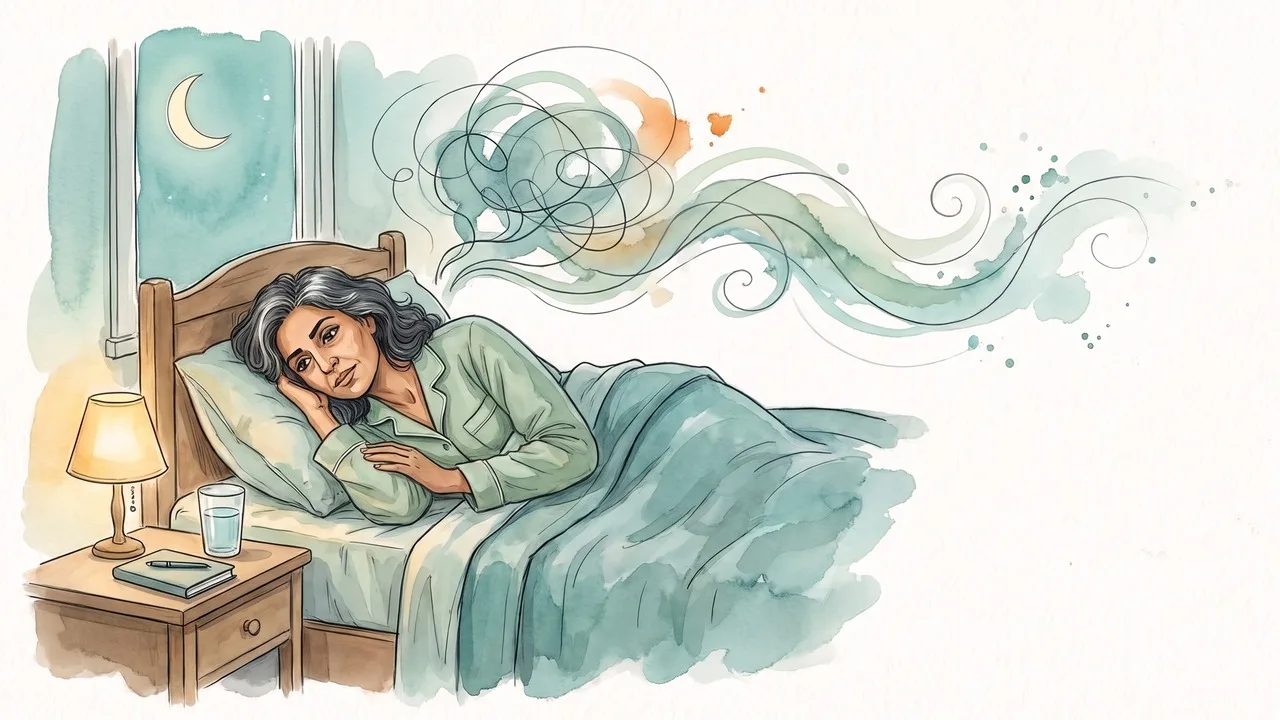
You wake in the dark. The house is quiet. You check the time, because of course you do. 3:07.
Then the thoughts arrive. The thing you said at work. The bill. Whether you'll cope tomorrow on this little sleep.
By 3:20, you're no longer thinking about the thing you said. You're thinking about being awake.
Almost everyone has had this night. So why does the mind get so loud at 3 AM, and is there anything that helps?
We read the sleep research people share, a brand new trial of mindfulness for insomnia, and what Seneca and the Yoga Sutras said about sleep and the mind. The honest answer: waking up is normal, the loop is the problem, and the loop can be loosened. Not with a trick that works every night.
Why do I wake up at 3am, and why does the mind get so loud once you do? This article looks at what a 2020 meta-analysis, a clock watching experiment, a bedtime list study, a 2026 mindfulness trial and an October 2026 preprint actually found, what Seneca and the Yoga Sutras say about sleep and the mind, and a gentle plan for your next night awake. We label each claim so you can see how solid it is:
- SUPPORTED: backed by a systematic review, meta-analysis or major guideline
- EMERGING: promising but early, small, uncontrolled, or mixed
- TRADITIONAL: what a tradition teaches, or the history of a practice
- PHILOSOPHICAL: interpretation, not a testable fact
- SPECULATIVE: a reasonable idea not yet shown
Why do I wake up at 3am? The idea, simply
Sleep isn't one long block. It runs in cycles of about 80 to 100 minutes, four to six a night, and you may wake briefly between cycles. SUPPORTED
Most of these wakings pass without us noticing. As the night goes on we spend more time in lighter sleep, so a brief waking is easier to notice. SUPPORTED
So waking at 3 AM is usually not the problem. What the mind does next is.
Researchers treat worry and rumination as related but different. In everyday words, worry leans toward "what if" and rumination toward replaying, "why did I" and "what's wrong with me". That plain wording is ours.
In one study of 242 adults with an insomnia disorder, people who ruminated a lot had worse sleep efficiency and more time awake in the night than people who ruminated less. Worry on its own didn't split the groups that way. EMERGING
The ancient lens: Seneca's evening review and the Yoga Sutras
In On Anger, Book 3, chapter 36, Seneca describes a bedtime habit he took from a teacher called Sextius. When the day was over and he had gone to rest, Sextius asked his spirit: "What bad habit of yours have you cured to-day? what vice have you checked? in what respect are you better?" (tr. Aubrey Stewart, 1889) TRADITIONAL
Seneca did the same. "When the lamp is taken out of my sight, and my wife, who knows my habit, has ceased to talk, I pass the whole day in review before myself." He wasn't harsh about it. "I conceal nothing from myself," he writes, and then, "I pardon you this time: see that you never do that any more." TRADITIONAL
He says the sleep that follows is sweet and sound. That is his report, not a study. TRADITIONAL
To us, what stands out is what his review has that rumination lacks: a set time, an honest look, a verdict and a next step. Then the lamp goes out. That reading is ours. PHILOSOPHICAL
The Yoga Sutras name sleep itself as one of the mind's waves. In Swami Vivekananda's translation, sutra 1.10 says "Sleep is a Vritti which embraces the feeling of voidness," and a vritti is a wave in the mind. His commentary calls a dream "another form of the ripple which in the waking state is called memory." TRADITIONAL
On how to quiet the waves, sutra 1.12 says: "Their control is by practice and non-attachment." And sutra 1.38 lists "meditating on the knowledge that comes in sleep" as one option. That is not advice for insomnia, and we won't stretch it into one. TRADITIONAL
Non-attachment, to us, sounds like letting a thought arrive without grabbing it and following it down the stairs. That reading is ours. PHILOSOPHICAL
The modern evidence: what studies show about night rumination
The link. A 2020 meta-analysis pooled 55 sets of results from people without a sleep disorder. More worry and rumination went with poorer sleep quality, a little less sleep and slower falling asleep. The links were small to medium, and they show that the two travel together, not which one causes the other. SUPPORTED
The clock. In one experiment, 30 good sleepers and 30 poor sleepers were told either to watch a clock or not while trying to fall asleep. The clock watchers reported more worry and took longer to fall asleep, in both groups. In a second experiment, 38 people with insomnia watched either a clock or a plain digit display, and the clock group again reported more worry before sleep. These were small, short experiments. EMERGING
The bedtime list. In a sleep lab, 57 healthy young adults spent 5 minutes writing before bed. Half wrote a to-do list for the next few days. Half wrote about what they had already done. The to-do group fell asleep significantly faster, and the more specific their list, the faster they fell asleep. Among those who wrote about completed tasks, the trend ran the other way. EMERGING
It was one night, in young adults, and the study didn't measure worry itself, so the authors say the mechanism needs more work. EMERGING
The mindfulness trial. A new trial in China randomly assigned 82 adults with chronic insomnia to 8 weeks of online mindfulness-based cognitive therapy for insomnia with a therapist, or to a single online lesson on sleep habits. After 8 weeks, insomnia scores had dropped about 4 points more in the therapy group, and their odds of reaching remission were about six times higher. Most benefits were still there at 20 weeks. EMERGING
But people knew which group they were in, the comparison group got far less attention, and the program mixed standard insomnia therapy with mindfulness. So it can't tell us that meditation alone fixes sleep. EMERGING
The honest limit. An October 2026 preprint, not yet peer reviewed, followed 120 older adults without real sleep problems. After 18 months of meditation training, the only difference from people who did nothing was that waking up in the morning felt easier. No change showed up in wrist monitors or in overnight brain recordings. Meditation may change how sleep feels more than how it measures. EMERGING
The bigger picture. For people with chronic insomnia, the American College of Physicians and the American Academy of Sleep Medicine both recommend cognitive behavioral therapy for insomnia (CBT-I) as the first treatment. SUPPORTED